|
|
|
|
 |
| Adamite |
|
|
Discovered in 1866 IMA status: Valid (pre-IMA; Grandfathered) | |||
|
|
|
Chemistry |
|
|
| |
|
Zn2(AsO4)(OH) | |
|
|
Zinc Arsenate Hydroxide |
|
Molecular Weight: |
286.71 gm |
|
Composition: |
Zinc |
45.61 % |
Zn |
56.78 % |
ZnO |
|
|
Arsenic |
26.13 % |
As |
40.08 % |
As2O5 |
|
|
Hydrogen |
0.35 % |
H |
3.14 % |
H2O |
|
|
Oxygen |
27.90 % |
O |
|
|
|
|
|
100.00 % |
|
100.00 % |
= TOTAL OXIDE |
|
|
|
||||
|
Classification |
|
|
| |
|
Phosphates | |
|
7/B.06-30 | |
|
|
8 : PHOSPHATES, ARSENATES, VANADATES
|
|
Related to: |
Olivenite Group. Adamite-Olivenite Series. The orthorhombic dimorph of Paradamite. Isostructural with Olivenite and Libethenite. |
|
Members of Group: |
Olivenite Group: Adamite, Eveite, Libethenite, Olivenite, Paraadamite, Tarbuttite, Zincolibethenite, Zincolivenite |
|
Varieties: |
Alumino Adamite, Cobaltoan Adamite, Cuprian Adamite (Cuproadamite), Manganoan Adamite (Manganadamite), Nickeloan Adamite |
|
Synonyms: |
Adamine, Adamite (of Friedel) |
|
|
|
|
Crystal Data |
|
|
|
|
|
Crystals are typically elongated, to 8 cm, may be tabular or equant; many other forms, usually in radial aggregates, fanlike rosettes, or crystalline crusts. |
|
|
None |
|
|
|
|
|
Physical Properties |
|
|
|
|
|
Good on {101}, Poor on {010} |
|
|
Irregular, Uneven to Subconchoidal |
|
|
Very Brittle |
|
|
3.5 |
|
|
4.32 - 4.38 (g/cm3) |
|
|
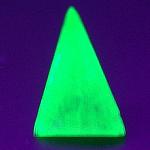
May fluoresce and phosphoresce lemon-yellow or bright green under SW and LW UV. |
|
|
Not Radioacitve |
|
|
|
|
|
Optical Properties |
|
|
|
|
|
Pale yellow, honey-yellow, brownish yellow, reddish; rarely white, colorless, blue, pale green to green, may be zoned; bright green (cuprian); bright pink, rose, or purple (cobaltian); in transmitted light, colorless or faintly tinted. |
|
|
Transparent to Translucent |
|
|
Vitreous, Resinous |
|
|
1.708 - 1.773 Biaxial ( +/- ) |
|
|
0.055 |
|
|
Strong; r > v or r < v |
|
|
Weak; in pale colors if cuprian or cobaltian |
|
|
|
|
|
Occurances |
|
|
|
|
|
Geological Setting: |
A secondary mineral in the oxidized zone of zinc- and arsenic-bearing hydrothermal mineral deposits. |
|
Common Associations: |
Smithsonite, Hemimorphite, Scorodite, Olivenite, Limnoite, Calcite, Quartz, Fe–Mn oxides |
|
Common Impurities: |
Cu, Mn |
|
Type Locality: |
Chañarcillo, Copiapó Province, Atacama Region, Chile |
|
Year Discovered: |
1866 |
|
View mineral photos: | |
|
|
|
|
Unusual Gem Categories |
|
|
|
|
|
| |
|
|
|
|
More Information |
|
|
|
|
|
| |
|
|
|
|
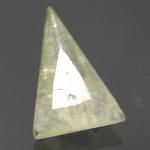
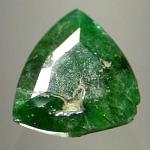
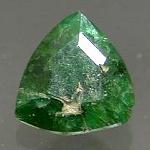
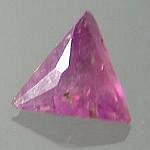
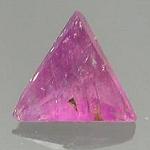
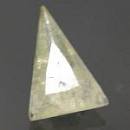
Adamite is a rare zinc phosphate mineral that belongs to the Olivenite Group of minerals that also includes Tarbuttite among others. It is a secondary mineral found in zinc deposits containing arsenic-bearing minerals. Adamite is very popular among collectors of fluorescent minerals because of its bright yellow to green fluorescence under short wave UV light. If you hover your cursor over the picture at the top of this page you will see the bright green fluorescence the gem exhibits under shortwave UV light. Adamite is isostructural with the minerals Olivenite and Libethenite. This means they share the same crystal symmetry and similar crystal shapes. There are several varieties of Adamite that are based on additional chemicals added to the Adamite formula. These are Alumino Adamite, Cobaltoan Adamite, Cuprian Adamite (Cuproadamite), Manganoan Adamite (Manganadamite), Nickeloan Adamite. Of these, I have only found two of these varieties that have been faceted; Cuprian Adamite and Manganoan Adamite. Adamite was named in 1866 by French chemist and mineralogist Charles Friedel (1832-1899) in honor of Gilbert-Joseph Adam (1795-1881), Auditor of Finance for the French Government, who supplied the first specimens of the mineral. Adam was a wealthy mineral collector and his mineral collection was described in Annales des Mines in 1869 and also in a published catalog the same year. Adam's mineral collection was eventually acquired by the École des Mines, Paris, France. He was a member of Société géologique de France and received the honor of Commandeur de la Légion d'Honneur. Adam was also the discoverer of the minerals Aerugite, Chenevixite, Corkite, Cuprotungstite, Scacchite, and Xanthiosite. Although there are many sources of Adamite mineral specimens, there has been only one source of gem quality crystals, the Ojuela Mine, Mapimí, Mun. de Mapimí, Durango, Mexico. There have been some beautiful, deep green crystals found at the Tsumeb Mine, Tsumeb, Otjikoto Region, Namibia, but these are generally too small for faceting. Adamite distribution: a number of localities; some for studied material or fine specimens include: from Chañarcillo, south of Copiapó, Atacama, Chile. In Mexico, large crystals at the Ojuela mine, Mapimí, Durango; in the Hidalgo mine, Zimapán, Hidalgo; and from Santa Eulalia, Chihuahua. In the USA, at Gold Hill, Tooele County, Utah, and in the Mohawk mine, Clark Mountains, San Bernardino County, California. At the Cap Garonne mine, near le Pradet, Var, France. From Reichenbach, near Bensheim, Hesse, and in the Clara mine, near Oberwolfach, Black Forest, Germany. In England, from several places in Cornwall, and at Caldbeck Fells, Cumbria. In the Kamariza mine, Laurium, Greece. Large crystals from Tsumeb, Namibia. At the Puttapa zinc mine, near Beltana, and on Mt. Painter, Flinders Ranges, South Australia. |
|
|
Adamite gems for sale:
|
|||||||||||||||||||||||||||||||||||||||||||||||||||||||||||||||||||||||||||||||||