|
|
|
|
 |
| Apatite (Fluorapatite) |
|
|
Discovered in 1823; IMA status: Valid (pre-IMA; Grandfathered) | |||
|
|
|
Chemistry |
|
|
| |
|
Ca5(PO4)4F | |
|
|
Calcium Fluoro Phosphate |
|
Molecular Weight: |
504.30 gm |
|
Composition: |
Calcium |
39.74 % |
Ca |
55.60 % |
CaO |
|
|
Phosphorus |
18.43 % |
P |
42.22 % |
P2O5 |
|
|
Oxygen |
38.07 % |
O |
|
|
|
|
Fluorine |
3.77 % |
F |
3.77 % |
F |
|
|
|
- % |
F |
-1.59 % |
-O=F2 |
|
|
|
100.00 % |
|
100.00 % |
= TOTAL OXIDE |
|
|
|
||||
|
Classification |
|
|
| |
|
Phosphates | |
|
7/B.39-10 | |
|
|
8 : PHOSPHATES, ARSENATES, VANADATES
|
|
Related to: |
Apatite Group. Apatite Subgroup. Apatite Supergroup. The fluorine analogue of Chlorapatite and Hydroxylapatite. The phosphate analogue of Svabite. The Ca5 analogue of Belovite-(Ce), Belovite-(La), and Kuannersuite-(Ce). |
|
Members of Group: |
Alforsite, Carbonate-rich Fluorapatite, Chlorapatite, Fluorapatite, Hydroxylapatite, Hydroxylapatite-M, Hydroxylpyromorphite, Johnbaumite, Johnbaumite-M, Manganapatite, Mimetite, Mimetite-2M, Miyahisaite, Mn-bearing Fluorapatite, Oxypyromorphite, Pieczkaite, Pyromorphite, Stronadelphite, Svabite, Turneaureite, Unnamed (F-analogue of Pyromorphite), Unnamed (OH-analogue of Mimetite), Vanadinite |
|
Members of Subgroup: |
Apatite Subgroup: Carbonate-rich Fluorapatite, Carbonate-rich Hydroxylapatite, Chlorapatite, Fluorapatite, Fluorstrophite, Hydroxylapatite |
|
Members of Supergroup: |
Apatite Supergroup: Apatite Subgroup, Pyromorphite Subgroup, Svabite Subgroup |
|
Varieties: |
Carbonate-rich Fluorapatite, Cuproapatite, Francolite, Holmbushite, Mn-bearing Apatite-(CaF), Saamite, Soda-Dehrnite, Staffelite, Strontian Apatite, Sulphatapatit |
|
Synonyms: |
Asparagus Stone, Augustite, Apatite-(CaF), Chlor-fluorapatite, Chrysolite d'Espagne, Crisolito de España, Fluor-apatite, Hydroxyl-fluorapatite, Mangualdite, Moroxite, Nauruite, Oxyapatite, Voelckerite, Wilkeite |
|
|
|
|
Crystal Data |
|
|
|
|
|
As prismatic hexagonal crystals, elongated on [0001], dominated by {1010} and {1011}, to 2 m; as complex tabular to discoidal crystals flattened on {0001}, typically with many forms; granular, globular to reniform, nodular, massive. |
|
|
Rare contact twins on {1121}. Twin plane {1013} rare. Also twinning reported on {1010} and {1123}. |
|
|
|
|
|
Physical Properties |
|
|
|
|
|
Poor/Indistinct on {0001} and {1010} |
|
|
Irregular/Uneven, Conchoidal |
|
|
Brittle |
|
|
5.0 (a Mohs hardness reference species) |
|
|
3.10 - 3.25 (g/cm3) |
|
|
Often fluorescent; exhibiting bright yellow or blue-white fluorescence under UV light. May also be phosphorescent, especially the manganoan varieties. Also strongly thermoluminescent at times. |
|
|
Not Radioactive |
|
|
|
|
|
Optical Properties |
|
|
|
|
|
Green, violet, purple, blue, pink, yellow, brown, white, colorless; may be zoned. Colorless or faintly tinted in thin section. |
|
|
Transparent to Opaque |
|
|
Vitreous to Sub-Resinous |
|
|
1.631 - 1.646 Uniaxial ( - ) |
|
|
0.0020 |
|
|
Weak; 0.013 |
|
|
Visible; weak to strong in colored crystals |
|
|
|
|
|
Occurances |
|
|
|
|
|
Geological Setting: |
The most common rock-forming phosphate mineral. Accessory in most igneous rocks, important in syenites, alkaline rocks, carbonatites, granite pegmatites. Common in marbles and skarns, Ca-rich regional metamorphic rocks, Alpine-type fissures, and hydrothermal tin veins. An essential component of sedimentary phosphorites, common as a detrital or diagenetic component in oolitic ironstones and phosphatic carbonate rocks and shales. Residual in laterites. |
|
Common Associations: |
Diopside, Forsterite, Scapolite, Phlogopite, Chondrodite, Calcite, Magnetite. |
|
Common Impurities: |
OH, Cl, TR, La, Ce, Pr, Nd, Sm, Eu, Gd, Dy, Y, Er, Mn |
|
Type Locality: |
Sauberg Mine, Ehrenfriedersdorf, Erzgebirge, Saxony, Germany |
|
Year Discovered: |
1823 |
|
View mineral photos: | |
|
|
|
|
Unusual Gem Categories |
|
|
|
|
|
| |
|
|
|
|
More Information |
|
|
|
|
|
|
Mindat.org
(Fluorapatite) |
|
|
|
|
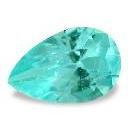
Apatite is not a specific mineral name but the name of a series of minerals that includes Fluorapatite, Chlorapatite and Hydroxylapatite. Apatite is also a generic name used to describe any of the three minerals which have not been specifically identified through analytical methods. Fluorapatite is by far the most common of the three to be used for gemstones but is usually refered to simply as "Apatite" in the gem trade. Fluorapatite is the fluorine (F) analogue of Chlorapatite, containing chlorine (Cl), and the water-rich (OH) Hydroxylapatite. It is difficult to tell the three apart and various amounts of fluorine, chlorine and water are present in most mineral specimens. Fluorapatite is also the phosphate (PO) analogue of Svabite. The three minerals of the Apatite series are also members of the Apatite Group of minerals that includes Mimetite, Pyromorphite, Svabite and Vanadinite. Apatite is fairly common througout the world and a modified form of Hydroxylapatite is the main constituent of human bones and dental enamel. Apatite occurs in almost all igneous rocks but is usually just small disseminated grains or cryptocrystalline fragments. Large, well formed crystals can be found in certain contact metamorphic rocks. Gem quality Apatite crystals are found in a number of places around the world, including Brazil, Burma, Mexico and Madagascar. Apatite gems are available in colors of green, blue, violet, purple, pink, yellow, brown and colorless. Neon blue to blue-green Apatite from Madagascar is one of the rarest and most sought after colors. Blue cat's-eye Apatite from Brazil and Madagascar is also rarely available. Green Apatite has been called asparagus stone and a bluish-green variety of Apatite originally found in Arendal, Norway has been called moroxite. Apatite can be a magnificent gem when properly cut although it is too soft for most jewelry settings. Apatite is the defining reference mineral for 5 on the Mohs scale of hardness. Apatite often exhibits bright yellow or blue white fluorescence under UV light and may also be phosphorescent, especially the manganoan varieties. It is also strongly thermoluminescent at times. Apatite was named in 1786 by German geologist Abraham Gottlob Werner (1749-1817), professor of mining and mineralogy at the Freiberg Mining Academy, Germany. Werner named the mineral from the Greek word άπατάω (apatein) meaning to deceive or to be misleading because it was often confused with other minerals such as Peridot and Beryl. The specific mineral that Werner had described as Apatite was reclassified in 1860 as Fluor-apatite by the German mineralogist Karl Friedrich August Rammelsberg (1813-1899). Rammelsberg added the "Fluor-" prefix in allusion to the dominance of fluorine (F) in the composition. In 2008 Fluorapatite was renamed Apatite-(CaF) in an article titled "Tidying up Mineral Names: an IMA-CNMNC Scheme for Suffixes, Hyphens and Diacritical Marks" in the Mineralogical Record, vol. 39, no. 2 (March–April 2008), page 132, but this name was then reversed and renamed Fluorapatite by the IMA in 2010. Despite the naming and renaming, it is still most often called Apatite. A few of the localities for fine Apatite crystals include: at Ehrenfriedersdorf, Saxony, Germany. From Untersulzbachtal, Salzburg, Austria. At Panasqueira, Portugal. From near Pech, Kunar Province, Afghanistan. At Chumar Bakhoor, Nagar, Gilgit district, Pakistan. In Brazil, at the Morro Velho gold mine, Nova Lima, Minas Gerais and at Currais Novos, Rio Grande do Norte. From Llallagua, Potosí, Bolivia. At Cerro de Mercado, Durango, Mexico. From the Pulsifer quarry, Mt. Apatite, Auburn, Androscoggin County, Maine, USA. In Canada, large crystals from southeastern Ontario, as in Renfrew County, and in adjoining southwestern Quebec, as in Ottawa County, etc. An important ore in carbonatites; in Russia, in the Khibiny and Kovdor massifs, Kola Peninsula; from the Slyudyanka region, Lake Baikal, eastern Siberia. At Phalaborwa, Transvaal, South Africa. From the Jacupiranga mine, São Paulo, and at Tapira, Minas Gerais, Brazil. In the Mt. Weld carbonatite, 35 km south of Laverton, Western Australia. At Ankarafa, Vohémar District, Sava Region, Antsiranana Province, Madagascar. |
|
|
Apatite gems for sale: We have not photographed our Apatite gems yet. Check back soon! |
