Click on a letter above to view the list of gems.    


Bowenite (a variety of Antigorite)
Current inventory:  1 gem
 

Bowenite

  
Bowenite was named by James D. Dana in 1850 for George T. Bowen, who first analyzed the mineral from Rhode Island in 1822. Antigorite is named after the type locality, Antigorio Valley, Piedmont, Italy.

Discovered in 1822;   IMA status: Not Valid (a variety of Antigorite)


Chemistry


Chemical Formula:

(Mg,Fe2+)3(Si2O5)(OH)4


Magnesium Iron Silicate Hydroxide

Molecular Weight:

300.77 gm

Composition:

Magnesium

18.18 %

Mg

30.15 %

MgO


Iron

13.93 %

Fe

17.92 %

FeO


Silicon

18.68 %

Si

39.95 %

SiO2


Hydrogen

1.34 %

H

11.98 %

H2O


Oxygen

47.88 %

O


100.00 %


100.00 %

= TOTAL OXIDE


Classification


Mineral Classification:

Silicates (Germanates)

Strunz 8th Ed. ID:

8/H.27-10

Nickel-Strunz 10th Ed. ID:

9.ED.15


9 : SILICATES (Germanates)
E : Phyllosilicates
D : Phyllosilicates with kaolinite layers composed of tetrahedral and octahedral nets

Related to:

Serpentine Group (Kaolinite-Serpentine Group). Closely related to Chrysotile and Lizardite. Polymorphous with Clinochrysotile, Lizardite, Orthochrysotile, and Parachrysotile.

Members of Group:

Serpentine Group: Amesite, Antigorite, Berthierine, Brindleyite, Caryopilite, Chrysotile, Clinochrysotile, Cronstedtite, Dickite, Fraipontite, Greenalite, Halloysite, Kaolinite, Kellyite, Lizardite, Manandonite, Nacrite, Népouite, Odinite, Orthochrysotile, Parachrysotile, Pecoraite

Varieties:

None

Synonyms:

Nephrite (of Bowen), Tangawaite, Tangiwai, Tangiwaite


Crystal Data


Crystallography:

Monoclinic - Domatic

Crystal Habit:

Typically massive material, also minute crystals, typically platy, rarely elongated; some plates have rectangular outline due to cleavage; commonly bladed or fibrous.

Twinning:

May exhibit two- or three-fold twins rotated 60° about an axis.


Physical Properties


Cleavage:

Perfect on {001}, observed on {100} and {010}

Fracture:

Irregular/Uneven, Conchoidal or Splintery

Tenacity:

Sectile

Moh's Hardness:

4.0 - 6.0

Density:

2.40 - 2.79 (g/cm3)

Luminescence:

None

Radioactivity:

Not Radioactive


Optical Properties


Color:

Pale to dark Green, pale to dark Bluish-Green

Transparency:

Transparent, Translucent, Opaque

Luster:

Resinous, Greasy, Pearly, Waxy

Refractive Index:

1.562 - 1.574  Biaxial  ( - )

Birefringence:

0.0050 - 0.0060

Dispersion:

Weak; r > v

Pleochroism:

n/a


Occurances


Geological Setting:

Commonly replaces ultramafic rocks, pervasively or in crosscutting veinlets. As a replacement of siliceous dolostone along contacts with diabase sills.

Common Associations:

Chromite, Magnetite, Chrysotile, Olivine

Common Impurities:

Ni, Al, Mn

Type Locality:

Dexter Quarry (Dexter Lime Quarry), Lime Rock, Lincoln, Providence Co., Rhode Island, USA

Year Discovered:

1822

View mineral photos:

Bowenite Mineral Photos and Locations
Antigorite Mineral Photos and Locations


More Information


Mindat.org  (Bowenite)
Mindat.org  (Antigorite)
Webmineral.com  (Antigorite)


Bowenite is a rare member of the Serpentine group of minerals that includes Antigorite, Bowenite, Lizardite and
Williamsite. Bowenite is a variety of the mineral Antigorite but is much more transparent and has a hardness of 4.0 - 6.0 compared to Antigorite's 2.5 - 3.5. Both are found in shades of green to pale yellowish green but Bowenite can also be found as pale (almost colorless) to dark bluish green. Some Bowenite gems can have a beautiful, pearly luster.

Bowenite was originally named by James D. Dana in 1850 after George T. Bowen who first analyzed material from Rhode Island in 1822 (although he misidentified the material as being related to nephrite jade).  In 1853 George J. Brush and J. L. Smith of Yale University found the mineral to be identical with Serpentine.  Bowenite was declared the state mineral of Rhode Island in 1966.

The main source of Bownite is the Soochow region of China but is also found in Afghanistan and in the USA at Eustis, Maine; Stoneham, Massachusettes; New Rochelle, New York; Dexter Quarry (the Type Locality), Lincoln, Rhode Island; and Newfane, Vermont.


Bowenite gems for sale:

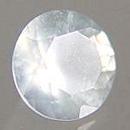
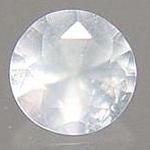
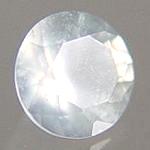
Bowenite-001

Gem:

Bowenite

Stock #:

BOW-001

Weight:

0.2165 ct

Size:

4.03 x 2.78 mm

Shape:

Round

Color:

Very pale pearly blue - colorless

Clarity:

Eye Clean (pearly)

Origin:

Soochow region, China

Treatment:

None (natural)

Price:

SOLD

Pictures are of the actual gem offered for sale.
Gem images are magnified to show detail.

Bowenite-001

A rare gem from China with a beautiful very pale blue pearly luster.


I love Sarah