|
|
|
|
 |
| Chondrodite |
|
|
Discovered in 1817; IMA status: Valid (pre-IMA; Grandfathered) | |||
|
|
|
Chemistry |
|
|
| |
|
(Mg,Fe2+)5(SiO4)2(F,OH)2 | |
|
|
Magnesium Iron Silicate Fluoride Hydroxide |
|
Molecular Weight: |
382.12 gm |
|
Composition: |
Magnesium |
23.85 % |
Mg |
39.55 % |
MgO |
|
|
Iron |
18.27 % |
Fe |
23.50 % |
FeO |
|
|
Silicon |
14.70 % |
Si |
31.45 % |
SiO2 |
|
|
Hydrogen |
0.13 % |
H |
1.18 % |
H2O |
|
|
Oxygen |
35.59 % |
O |
|
|
|
|
Fluorine |
7.46 % |
F |
7.46 % |
F |
|
|
|
- % |
F |
-3.14 % |
-O=F2 |
|
|
|
100.00 % |
|
100.00 % |
= TOTAL OXIDE |
|
|
|
||||
|
Classification |
|
|
| |
|
Silicates (Germanates) | |
|
8/B.04-20 | |
|
|
9 : SILICATES (Germanates)
|
|
Related to: |
Humite Group. Dimorph of Ribbeite. Isostructural with Alleghanyite, Chegemite, Edgrewite, Hydroxylchondrodite, Hydroxylclinohumite, Kumtyubeite, Manganhumite, Norbergite, Reinhardbraunsite, Sonolite. |
|
Members of Group: |
Humite Group: Alleghanyite, Chegemite, Chondrodite, Clinohumite, Edgrewite, Humite, Hydroxylchondrodite, Hydroxylclinohumite, Jerrygibbsite, Kumtyubeite, Leucophoenicite, Manganhumite, Norbergite, Reinhardbraunsite, Ribbeite, Sonolite |
|
Varieties: |
None |
|
Synonyms: |
Brocchite, Brucite (of Gibbs), Condrodite, Fluosiderite (F-rich Chondrodite), ICSD 15180, Maclureite (of Nuttall), PDF 12-52, Prolectite |
|
|
|
|
Crystal Data |
|
|
|
|
|
Crystals rare, varied in habit, typically flattened || [010], to 10 cm. Commonly as rounded grains, massive. |
|
|
On {001}, common, simple and lamellar; possibly || {015} and {305}. |
|
|
|
|
|
Physical Properties |
|
|
|
|
|
Indistinct on {100}; parting on {001} |
|
|
Conchoidal |
|
|
Brittle |
|
|
6.0 - 6.5 |
|
|
3.1 - 3.2 (g/cm3) |
|
|
Not all specimens exhibit fluorescence. Fluorescent specimens show orange yellow under SW UV, orange under LW UV. |
|
|
Not Radioactive |
|
|
|
|
|
Optical Properties |
|
|
|
|
|
Light yellow, yellow, brown, red; in thin section, pale yellow or brown to colorless |
|
|
Transparent to translucent |
|
|
Vitreous to resinous |
|
|
1.592 - 1.675 Biaxial ( + ) |
|
|
0.027 - 0.032 |
|
|
Weak to strong; r > v |
|
|
X = colorless, very pale yellow, brownish yellow; Y = colorless, yellow-green; Z = colorless, pale green |
|
|
Fairly strong; color in reflected light: white |
|
|
|
|
|
Occurances |
|
|
|
|
|
Geological Setting: |
In contact metamorphic zones, in limestones and dolostones, associated with felsic to alkalic plutonic rocks, especially with Fe-B-F metasomatism; in a carbonatite. |
|
Common Associations: |
Phlogopite, Spinel, Magnetite, Grossular, Wollastonite, Forsterite, Monticellite, Cuspidine, Diopside, Calcite |
|
Common Impurities: |
Ti, Al, Mn |
|
Type Locality: |
Skräbböle quarry, Pargas (Parainen), Southwestern Finland Region, Finland |
|
Year Discovered: |
1817 |
|
View mineral photos: | |
|
|
|
|
Unusual Gem Categories |
|
|
|
|
|
| |
|
|
|
|
More Information |
|
|
|
|
|
| |
|
|
|
|
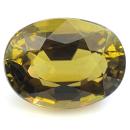
Chondrodite is a member of the Humite Group of minerals that includes Chondrodite, Clinohumite, Humite and Norbergite. Faceted Chondrodite is fairly rare. Faceted gems can be beautiful in colors of light yellow, yellow, brown and deep red to deep orangish red. Some Chondrodite gems may exhibit fluorescence of orangish-yellow under shortwave (SW) UV light and orange under longwave (LW) UV light. If you hover your cursor over the picture above, you will see the Chondrodite gem exhibiting fluorescence under UV light. Chondrodite was named in 1817 by Swedish historian Baron Abraham Constantin Mouradgea d'Ohsson (1779-1851) from the Greek word Χόνδρος (chondros) meaning grain in allusion to its habit of occurring in isolated grains. d'Ohsson called Chondrodite "a yellow stone from Pargas". There are several sources of Chondrodite around the world, but only a few produce facetable crystals. One source of small gemmy crystals is the Tilly Foster Mine in Brewster, New York. Other sources are Badakhshan (Badakshan; Badahsan) Province, Afghanistan; Palabora mine, Loolekop, Phalaborwa, Limpopo Province, South Africa; and Mogok, Sagaing District, Mandalay Division, Myanmar (Burma). Distribution: from Pargas, Hangelby, and Sibbo, Finland. At Kafveltorp, near Kopparberg, Sweden. From Monte Somma and Vesuvius, Campania, Italy. At Le Chipal, Vosges, France. From Bhandara, Maharashtra, India. In the USA, fine crystals from the Tilly Foster mine, Brewster, Putnam County, and Amity, Orange County, New York; at Franklin and Sparta, Sussex County, New Jersey; Johnson Camp, Cochise County, and the Lakeshore mine, Pinal County, Arizona; and Crestmore, Riverside County, California. From Bancroft, Ontario, Canada. In the Loolekop carbonatite, Transvaal, South Africa. A few other localities are known. |
|
|
Chondrodite gems for sale: We have not photographed our Chondrodite gems yet. Please check back soon. |
