|
|
||||||||||||||||
|
||||||||||||||||
|
||||||
|
|
|
|
Magnesio-riebeckite
|
|
| | |
| Discovered in 1949; IMA status: Valid (pre-IMA; Grandfathered) | ||
|
| ||
|
Chemistry |
|
|
| |
|
Na2[(Mg,Fe2+)3Fe3+2]Si8O22(OH)2 | |
|
|
Sodium Magnesium Iron Silicate Hydroxide |
|
Molecular Weight: |
876.08 gm |
|
Composition: |
Potassium |
0.13 % |
K |
0.16 % |
K2O |
|
|
Sodium |
4.09 % |
Na |
5.52 % |
Na2O |
|
|
Calcium |
1.97 % |
Ca |
2.75 % |
CaO |
|
|
Magnesium |
5.35 % |
Mg |
8.88 % |
MgO |
|
|
Titanium |
0.16 % |
Ti |
0.27 % |
TiO2 |
|
|
Manganese |
0.31 % |
Mn |
0.45 % |
Mn2O3 |
|
|
Aluminum |
0.80 % |
Al |
1.51 % |
Al2O3 |
|
|
Iron |
17.47 % |
Fe |
12.06 % |
FeO / 11.57 % Fe2O3 |
|
|
Silicon |
25.65 % |
Si |
54.87 % |
SiO2 |
|
|
Hydrogen |
0.23 % |
H |
2.06 % |
H2O |
|
|
Oxygen |
43.83 % |
O |
|
|
|
|
|
100.00 % |
|
100.10 % |
= TOTAL OXIDE |
|
|
|
||||
|
Classification |
|
|
| |
|
Silicates (Germanates) | |
|
8/F.08-40 | |
|
|
9 : SILICATES (Germanates)
|
|
Related to: |
Riebeckite Group, Sodium Amphibole Subgroup, w(OH, F, Cl)-dominant Amphibole Group, Amphibole Supergroup. Magnesioriebeckite - Ribeckite Series. Glaucophane - Riebeckite - Kozulite Series. Magnesio-riebeckite is defined as a member of the Riebeckite Group with Mg>Fe2+ in the C2+ position and (OH) in the W position. |
|
Members of Group: |
Riebeckite Group: Fluoro-riebeckite, Magnesio-fluoro-riebeckite, Riebeckite |
|
Varieties: |
None |
|
Synonyms: |
Babadudenite, Ferri-glaucophane, Magnesian-riebeckite, Rhodusite, Svidneite, Ternovskite, Torendikite, Torendrickite, Torendrikite |
|
|
|
|
Crystal Data |
|
|
|
|
|
Rarely as prismatic crystals. Also columnar, fibrous, or granular aggregates. |
|
|
Simple or multiple twinning || {100}. |
|
|
|
|
|
Physical Properties |
|
|
|
|
|
Perfect on {110}; intersecting at ~58° and ~122°; partings on {010}, {001}. |
|
|
Conchoidal to Uneven |
|
|
Brittle |
|
|
5.0 - 6.0 |
|
|
3.12 - 3.29 (g/cm3) |
|
|
None |
|
|
Not Radioactive |
|
|
Health Warning: |
The asbestiform variety of Magnesio-riebeckite can cause lung disease when inhaled, as in other species of asbestos minerals. |
|
|
|
|
Optical Properties |
|
|
|
|
|
Light Blue, Dark Blue, Blackish Blue, Black |
|
|
Translucent to Opaque |
|
|
Vitreous, Silky |
|
|
1.668 - 1.680 Biaxial ( - ) or ( + ) |
|
|
0.0120 |
|
|
r > v or r < v |
|
|
Strong; X = dark blue; Y = indigo; Z = yellow-green |
|
|
|
|
|
Occurances |
|
|
|
|
|
Geological Setting: |
In granulites, ironstones, ferruginous metacherts, greenschist facies schists, and carbonatites. Veins in slightly metamorphosed sandstone and carbonates associated with evaporites. |
|
Common Associations: |
Epidote, Muscovite, Quartz, Stilpnomelane, Winchite |
|
Common Impurities: |
Ti, Al, Mn, Ca, K, H2O |
|
Type Locality: |
Alto Chapare District, Chapare Province, Cochabamba Department, Bolivia |
|
Year Discovered: |
1949 |
|
View mineral photos: | |
|
|
|
|
More Information |
|
|
|
|
|
| |
|
|
|
|
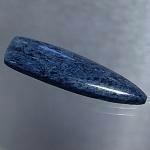
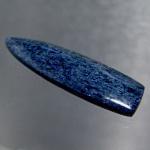
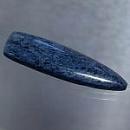
Magnesio-riebeckite may have originally been discovered by C. Palache in 1928 at the mines at Franklin, New Jersey, USA, but the specimen was incorrectly identified as Crocidolite. The year of discovery is noted as 1949 from the type locality of Alto Chapare District, Chapare Province, Bolivia. Magnesio-riebeckite and Riebeckite are closely related to the mineral Glaucophane. Glaucophane is named for its typical blue color. The name Glaucophane is from the Greek glaukos for "sky-blue" and phainestrai for "to appear", in allusion to its typical color. The blue color is very diagnostic for the two species and both are the only common amphibole minerals that are typically blue. There
are many localities for finding the fibrous "asbestiform"
material but only one source for the attractive solid,
deep blue
massive material: Krivoy Rog Basin, Dnipropetrovs'k Oblast' (Dnepropetrovsk Oblast'), Ukraine.
|
|