|
|
||||||||||||||||
|
||||||||||||||||
|
||||||
|
|
|
|
Musgravite
(Magnesiotaaffeite-6N’3S) |
|
| | |
| Discovered in 1967; IMA status: Valid (IMA approved 2002) | ||
|
| ||
|
Chemistry |
|
|
| |
|
(Mg,Fe2+,Zn)2Al6BeO12 | |
|
|
Magnesium Iron Zinc Aluminum Beryllium Oxide |
|
Molecular Weight: |
426.60 gm |
|
Composition: |
Magnesium |
9.69 % |
Mg |
16.06 % |
MgO |
|
|
Beryllium |
1.90 % |
Be |
5.28 % |
BeO |
|
|
Aluminum |
37.95 % |
Al |
71.70 % |
Al2O3 |
|
|
Zinc |
1.53 % |
Zn |
1.91 % |
ZnO |
|
|
Iron |
3.93 % |
Fe |
5.05 % |
FeO |
|
|
Oxygen |
45.00 % |
O |
|
|
|
|
|
100.00 % |
|
100.00 % |
= TOTAL OXIDE |
|
|
|
||||
|
Classification |
|
|
| |
|
Oxides | |
|
4/B.07-30 | |
|
|
4 : OXIDES (Hydroxides, V[5,6] vanadates, arsenites, antimonites,
bismuthites, sulfites, selenites, tellurites, iodates) |
|
Related to: |
Taaffeite Group. Chrysoberyl - Swedenburgite Series. 9R, 18R polytypoids. |
|
Members of Group: |
Taaffeite Group: Ferrotaaffeite-6N'3S (Pehrmanite), Magnesiotaaffeite-2N’2S (Taaffeite), Magnesiotaaffeite-6N’3S (Musgravite) |
|
Varieties: |
None |
|
Synonyms: |
Magnesiotaaffeite-6N3S, Musgravite |
|
|
|
|
Crystal Data |
|
|
|
|
|
Crystals platy on {0001}, to 0.5 mm; massive. |
|
|
None |
|
|
|
|
|
Physical Properties |
|
|
|
|
|
Perfect on {0001} (or a Parting); less Perfect on {1011} |
|
|
Platy |
|
|
Brittle |
|
|
8.0 - 8.5 |
|
|
3.68 (g/cm3) |
|
|
None |
|
|
Not Radioactive |
|
|
|
|
|
Optical Properties |
|
|
|
|
|
Light Olive Green, dark Greenish Blue, light to dark Violet; nearly Colorless in thin section |
|
|
Transparent to Translucent |
|
|
Vitreous |
|
|
1.719 - 1.739 Uniaxial ( - ) |
|
|
0.0070 |
|
|
n/a |
|
|
None |
|
|
|
|
|
Occurances |
|
|
|
|
|
Geological Setting: |
In a nodule, perhaps formerly a corundum crystal, in high-grade metapyroxenite, associated with metaperidotites and granulites (Musgrave Ranges, Australia); in pegmatite cutting granulite (Enderby Land, Antarctica). |
|
Common Associations: |
Phlogopite, Sapphirine, Spinel (Musgrave Ranges, Australia); Biotite, Garnet, Quartz, Sapphirine, Sillimanite, Surinamite (Enderby Land, Antarctica). |
|
Common Impurities: |
None |
|
Type Locality: |
Ernabella Mission, Musgrave Ranges, South Australia, Australia |
|
Year Discovered: |
1967, (IMA approved 2002) |
|
View mineral photos: | |
|
|
|
|
More Information |
|
|
|
|
|
| |
|
|
|
|
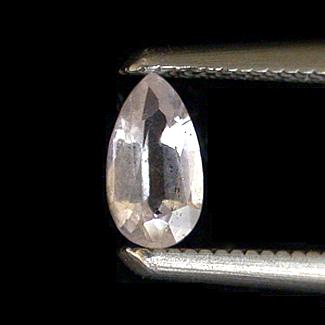
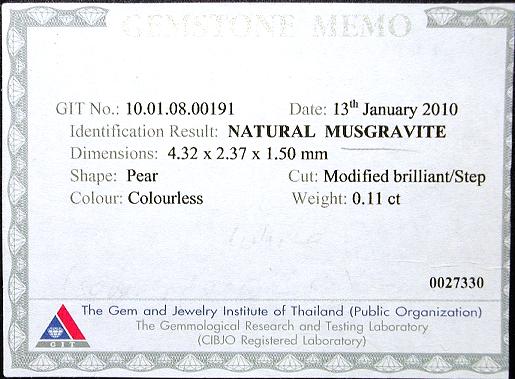
Musgravite was recently renamed by the IMA (International Mineralogical Association) and is now officially known as Magnesiotaaffeite-6N’3S. Musgravite was originally named after the Musgrave Ranges of Southern Australia where it was first discovered but has been renamed Magnesiotaaffeite-6N’3S by the IMA for its association with Taaffeite and its magnesium content. Musgravite was renamed as a method of clarifying the complexity of the compositions of Taaffeite Group minerals including Musgravite, Perhmanite and Taaffeite and the influences of the minerals Spinel and Nolanite on them. So, according to the new nomenclature accepted by the IMA, Musgravite has become Magnesiotaaffeite-6N’3S, as it is composed of six modified Nolanite modules (6N) and three Spinel modules (3S). Correspondingly, Taaffeite has become Magnesiotaaffeite-2N’2S and Perhmanite has become Ferrotaaffeite-6N’3S. Taaffeite is now an IMA approved name for the group of minerals containing Musgravite (Magnesiotaaffeite-6N’3S), Perhmanite (Ferrotaaffeite-6N’3S) and Taaffeite (Magnesiotaaffeite-2N’2S). The names Musgravite and Taaffeite have been relegated to trade name status. However, I suspect that these names will continue to be used in the gem trade as the individual gem names. Musgravite
has been found at the Type Locality 16 km north-northeast of Ernabella Mission, Musgrave
Ranges, South Australia; along Casey
Bay, Enderby Land, Antarctica and at Dove Bugt, northeast
Greenland. The only sources of facetable crystals are
at Tunduru, Tanzania and a very limited find in 2009
at Mogok, Burma. |
|
|
||||||||||||||||||||||||||||