|
|
||||||||||||||||
|
||||||||||||||||
|
||||||
|
|
|
|
Tremolite
|
|
| | |
| Discovered in 1790; IMA status: Valid (pre-IMA; Grandfathered) | ||
|
| ||
|
Chemistry |
|
|
| |
|
Ca2(Mg;Fe2+)5Si8O22(OH)2 | |
|
|
Calcium Magnesium Iron Silicate Hydroxide |
|
Molecular Weight: |
812.37 gm |
|
Composition: |
Calcium |
9.87 % |
Ca |
13.81 % |
CaO |
|
|
Magnesium |
14.96 % |
Mg |
24.81 % |
MgO |
|
|
Silicon |
27.66 % |
Si |
59.17 % |
SiO2 |
|
|
Hydrogen |
0.25 % |
H |
2.22 % |
H2O |
|
|
Oxygen |
47.27 % |
O |
|
|
|
|
|
100.00 % |
|
100.00 % |
= TOTAL OXIDE |
|
|
|
||||
|
Classification |
|
|
| |
|
SILICATES (Germanates) | |
|
8/F.10-10 | |
|
|
9 : SILICATES (Germanates)
|
|
Related to: |
Amphibole Group. Calcic Clino-Amphibole Subgroup. Tremolite - Sadanagaite Series. Tremolite - Parvo-manganotremolite Series. Actinolite - Tremolite Series. Ferro-Actinolite - Tremolite Series. |
|
Members of Supergroup: |
Amphibole Supergroup: Lithium Amphibole Subgroup, Lithium - (Magnesium - Iron - Manganese) Amphibole Subgroup, Lithium-Calcium Amphibole Subgroup, Magnesium - iron - manganese Amphibole Subgroup, Sodium Amphibole Subgroup, Sodium - (Magnesium - Iron - Manganese) Amphibole Subgroup, Sodium-Calcium Amphibole Subgroup |
|
Varieties: |
Chrome-Tremolite, Hexagonite |
|
Synonyms: |
Abhazite, Abkhazite, Calamite, Grammatite, Peponite, Raphilite, Säulenspath, Sebesite, Sternspath |
|
|
|
|
Crystal Data |
|
|
|
|
|
Elongated, stout prismatic, or flattened bladed crystals, to 20 cm; also fibrous, granular or columnar aggregates. |
|
|
Simple or multiple, common || {100}; rarely multiple || {001} |
|
|
|
|
|
Physical Properties |
|
|
|
|
|
Perfect on [110]; partings on [010], [100] |
|
|
Sub-Conchoidal |
|
|
Brittle |
|
|
5.0 - 6.0 |
|
|
2.99 - 3.03 (g/cm3) |
|
|
Fluorescent; SW UV = yellow, LW UV = pink |
|
|
Not Radioactive |
|
|
Health Warning: |
Asbestiform varieties of Tremolite can cause lung disease when inhaled, as with other species of asbestos minerals. |
|
|
|
|
Optical Properties |
|
|
|
|
|
White, Brown, Gray, Colorless, light to dark Green, light Yellow, Pink to Violet; colorless in thin section |
|
|
Transparent to Translucent, Opaque |
|
|
Vitreous, Silky |
|
|
1.599 - 1.637 Biaxial ( - ) |
|
|
0.0250 - 0.0260 |
|
|
Weak; r < v |
|
|
None |
|
|
|
|
|
Occurances |
|
|
|
|
|
Geological Setting: |
From contact metamorphism of Ca-Mg siliceous sediments; in greenschist facies metamorphics derived from ultramafic or magnesium carbonate rocks. |
|
Common Associations: |
Calcian Garnet, Calcite, Cummingtonite, Diopside, Dolomite, Forsterite, Magnesio-cummingtonite, Riebeckite, Talc, Winchite, Wollastonite |
|
Common Impurities: |
Ti, Mn, Al, Na, K, F, Cl, H2O |
|
Type Locality: |
Campolungo, Piumogna Valley, Leventina, Ticino (Tessin), Switzerland |
|
Year Discovered: |
1790 |
|
View mineral photos: | |
|
|
|
|
More Information |
|
|
|
|
|
| |
|
|
|
|
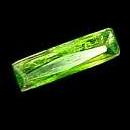
Tremolite was named by J.G.A. Höpfner for the Tremola valley (Val Tremola), Central St Gotthard Massif, Switzerland, where the type material supposedly came from, according to the dealer from whom he had acquired the specimens. Though, modern investigations of what is considered the type material, conserved at Geneva, revealed that the type locality is actually Campolungo. Val Tremola lying north of the isograde delineating the first appearance of Tremolite. The
only notable sources of gem quality crystals of Tremolite
are Harcourt, Haliburton County, Ontario, Canada; Outokumpu, Itä-Suomen Lääni, Finland;
Umba Valley region, Kenya; Northern Areas,
Astor District Astor,
Pakistan; Merelani Hills (Mererani), Lelatema Mts, Simanjiro District, Manyara Region, Tanzania.
In the
USA, from Pierrepont, Gouverneur, Edwards, and Macomb,
St. Lawrence County, New York; at Franklin, Sussex County,
New Jersey; and Lee, Berkshire County, Massachusetts.
|
|
|
We
have not photographed our Tremolite gems. Please
check back soon. |
