|
|
|
Click on a
letter above to view the list of gems. |
|
|
|
|
| Williamsite
is named named after L. W. Williams (1804-1873) who
first discovered it. Antigorite
is named after its discovery location of Antigorio Valley, Piedmont, Italy.
| | Discovered
in 1840 (Antigorite);
IMA
status: Williamsite is Not Valid; Antigorite is Valid
(pre-IMA; Grandfathered) | |
|
|
Chemistry
|
|
|
|
|
Chemical
Formula: |
(Mg;Fe2+)3Si2O5(OH)4 |
|
|
Magnesium
Iron Silicate Hydroxide |
|
Molecular
Weight: |
300.77 gm |
|
Composition: |
|
Magnesium |
18.18 %
|
Mg
|
30.15 %
|
MgO
|
|
Iron |
13.93 %
|
Fe
|
17.92 %
|
FeO
|
|
Silicon |
18.68 % |
Si |
39.95 % |
SiO2 |
|
Hydrogen |
1.34 % |
H |
11.98 % |
H2O |
|
Oxygen |
47.88 % |
O |
|
|
|
|
100.00 % |
|
100.00 % |
= TOTAL OXIDE |
|
|
|
|
Classification
|
|
|
|
|
Mineral
Classification: |
Silicates (Germanates)
|
|
Strunz 8th
Ed. ID:
|
8/H.27-10
|
|
Nickel-Strunz 10th
Ed. ID:
|
9.ED.15 |
|
|
9 : SILICATES (Germanates) E : Phyllosilicates D : Phyllosilicates with kaolinite layers composed of tetrahedral and octahedral nets
|
|
Related
to: |
Kaolinite-Serpentine
Group. Polymorphous with Clinochrysotile, Lizardite,
Orthochrysotile, and Parachrysotile.
|
|
Varieties: |
Al-Antigorite,
Andes Jade, Bowenite, Jenkinsite, Picrolite
|
|
Synonyms: |
Baltimorite,
Bastard Asbestos, Genthite, Gymnite, Iron-Gymnite, Nickel-Gymnite,
Porcellophite, Protoantigorite, Septeantigorite, Thermophyllite,
Williamsite, Yu yen shi stone, Yu yen stone, Zermattite
|
|
|
|
|
Crystal
Data
|
|
|
|
|
Crystallography:
|
Monoclinic
- Domatic
|
|
Crystal
Habit:
|
Minute
crystals, typically platy along [001], rarely elongated
along [010]; some plates have rectangular outline due
to cleavage; commonly bladed or fibrous.
|
|
Twinning:
|
May
exhibit two- or three-fold twins rotated 60° about an
axis [001].
|
|
|
|
|
Physical
Properties
|
|
|
|
|
Cleavage: |
{001}
Perfect, observed on {100} and {010}
|
|
Fracture: |
Conchoidal
or Splintery
|
|
Tenacity:
|
Brittle
|
|
Moh's
Hardness: |
3.5
- 4.0
|
|
Density:
|
2.50
- 2.60 (g/cm3)
|
|
Luminescence:
|
None |
|
Radioactivity:
|
Not
Radioactive
|
|
|
|
|
Optical
Properties
|
|
|
|
|
Color: |
Green,
Blue-Green, White; Colorless to pale Green in thin section.
|
|
Transparency: |
Translucent
to Sub-Opaque
|
|
Luster: |
Resinous,
Greasy, Silky, Waxy, Earthy
|
|
Refractive
Index: |
1.555
- 1.573 Biaxial ( - )
|
|
Birefringence: |
0.005
- 0.006
|
|
Dispersion: |
Weak;
r > v
|
|
|
|
|
Occurances
|
|
|
|
|
Geological
Setting: |
Commonly
replaces ultramafic rocks, pervasively or in crosscutting
veinlets. As a replacement of siliceous dolostone along
contacts with diabase sills. |
|
Common
Associations: |
Chromite,
Chrysotile, Magnetite, Olivine |
|
Common
Impurities: |
Ni,
Al, Mn |
|
Co-Type
Localities: |
(Antigorite)
Antigorio Valley, Ossola Valley, Verbano-Cusio-Ossola Province, Piedmont, Italy;
Geisspfad area, Binn Valley, Wallis (Valais), Switzerland |
|
Year
Discovered: |
1840
(Antigorite) |
|
View
mineral photos: |
Antigorite
Mineral Photos and Locations |
|
|
|
|
More
Information
|
|
|
|
|
|
Mindat.org
(Antigorite) Webmineral.com
(Antigorite)
|
|
|
|
|
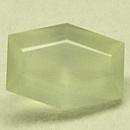
Williamsite
is a translucent to nearly transparent pale apple-green
variety of Antigorite. Antigorite is a member of the
Serpentine Group of minerals and Williamsite is sometimes
referred to as "Precious Serpentine" because
it closely resembles fine Jade. It commonly contains
minor inclusions of Chromite and Magnetite.
Williamsite
originally came from the historic State Line Chrome
Mine which lies just inside Lancaster County, Pennsylvania on
the Pennsylvania-Maryland border. This mine was active
from the 1800's into the early 1900's. Williamsite can
occassionally be found at Wood's Chrome Mine, Texas, Little Britain Township, Lancaster County, Pennsylvania, USA.
|
|
Williamsite
gems for sale:
We
have not photographed our Williamsite gems. Please
check back soon.
|
|